Remote and hybrid team building: 10 ideas that genuinely work
Explore 10 practical ideas for remote and hybrid team building, from short online rituals to an engaging live corporate event.
By Rewanż team
Remote and hybrid team building: 10 ideas that genuinely work
In short: Remote and hybrid teams need a different approach to relationship-building than teams that share an office every day. There are fewer spontaneous conversations, so shared experiences need to be planned more deliberately. These ten ideas range from simple online rituals to larger in-person events and are designed to involve the whole team, wherever people usually work.
A team that meets in the office every day builds relationships almost automatically - over coffee, in the kitchen, in the elevator. A remote or hybrid team doesn't have these random moments, so integration must be planned consciously and not left to chance. Below are ideas that actually work in practice - not only on paper.
1. Cyclical meeting without a working agenda
A short, regular online meeting where the team talks only about topics unrelated to projects - how the week went, what everyone is watching, what they are planning for the weekend. The key to success: a fixed time in the calendar and a clear "zero work topics" rule, otherwise the meeting quickly turns into another status update.
2. Play together online in short sessions
Simple browser games (quizzes, word games, small challenges) played in 15-20 minutes can build more natural competition and laughter than an hour-long conversation about nothing. They work particularly well as a permanent part of a regular team meeting.
3. Virtual challenge room with ranking
A long-term challenge (e.g. steps, knowledge quiz, guessing games) with a ranking visible to everyone keeps people engaged for weeks, not just during one meeting - the element of competition and visible progress is the strongest motivator in long-term formats.
4. Sharing breakfast or lunch online
A simple but underestimated form of integration - a shared meal with cameras on, without an agenda. It works best in small groups (up to 6-8 people), because a larger online group naturally loses the freedom to talk.
5. Integration onboarding for new people
Remote teams have a harder start for new employees than on-site teams - the lack of physical presence makes it difficult to get to know each other naturally. A short, structured welcome ritual (e.g. a round of icebreaker questions at the first meeting with the entire team) significantly accelerates relationship building.
6. Regular, short 1:1 meetings outside of project topics
Strong teams start with strong one-to-one relationships. A short monthly conversation between a manager and each team member — deliberately kept separate from project updates — can build trust that later supports better group collaboration.
7. A common channel for casual topics
Simple but effective: a separate communication channel (e.g. on Slack or Teams) intended only for casual topics - vacation photos, memes, recommended books. It works as the virtual equivalent of an office kitchen, as long as the team actually uses it rather than just putting it on.
8. A regular in-person event for hybrid teams
Hybrid teams benefit from regular in-person meetings — perhaps quarterly or twice a year — where everyone shares the same physical space. These less frequent but more immersive events can build relationships that no online format can fully reproduce.
9. A team event built around participation, not a presentation
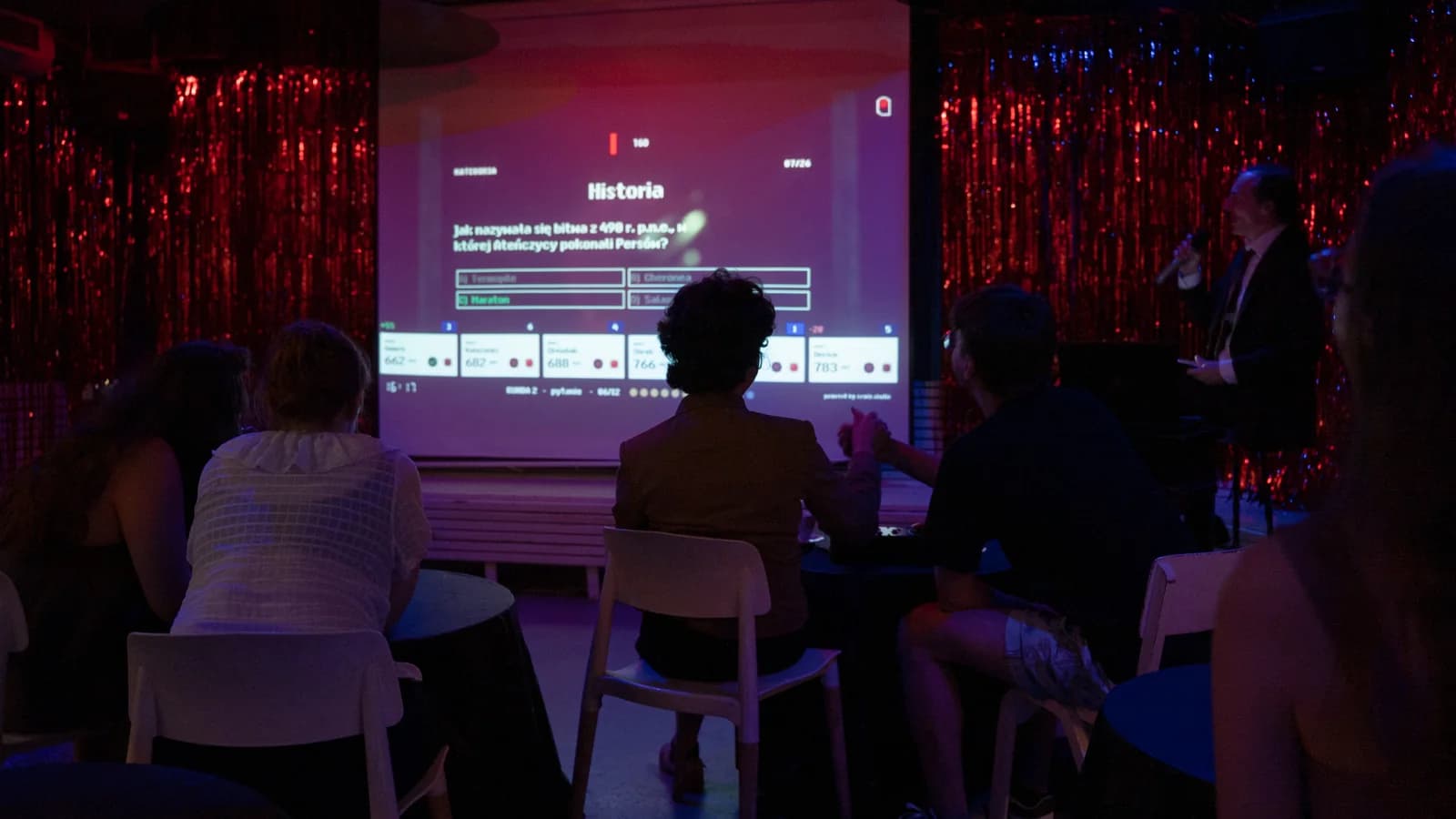
A large in-person event is most effective when it centres on a shared game that involves the whole team at once. Unlike a presentation or workshop, a competitive format with live scoring — such as a corporate game show — gives remote colleagues who know one another less well an easy way to join the same experience.
10. A corporate game show that brings a hybrid team together
A corporate game show works well for hybrid teams because participants do not need to know one another in advance. Clear rules and professional hosting give colleagues who may be meeting in person for the first time an easy way to take part. In Rewanż, the whole team plays simultaneously using physical controllers and competes through several rounds, naturally breaking the ice for people who usually know one another mainly through a screen.
Frequently asked questions
What are the best ideas for integrating a remote team? The most effective approach combines short, regular online rituals — informal meetings, shared games or team challenges — with less frequent in-person events that create experiences people cannot reproduce remotely.
What is the difference between integrating a hybrid team and a fully remote team? A hybrid team can also arrange periodic in-person meetings, giving it an additional relationship-building tool that may not be available to a fully distributed team.
Does team play work as an integration tool for people who don't know each other? Yes - a format based on clear rules of the game and hosted by a professional moderator, like a corporate game show, engages participants regardless of whether they know each other before, because it is based on universal rules of the game, not on previous relationships.
How often should a hybrid team meet in person? Quarterly or twice-yearly meetings often work well. Less frequent, immersive in-person experiences can have more impact than a larger number of short online sessions.
Want to see how a game show can bring a hybrid team together? Ask about a Rewanż event
See also: Why classic team building doesn't work (and what to do instead) · What is gamification and why it works better than a presentation or workshop · Psychology of competition: why people engage more in a game than in a conversation
Related articles
attractions for the conference
Conference entertainment: how to engage participants without disrupting the agenda
Read articlecorporate game show
Corporate game show: how it works, how long it lasts and which group sizes it suits
Read articleteam building for 50 people